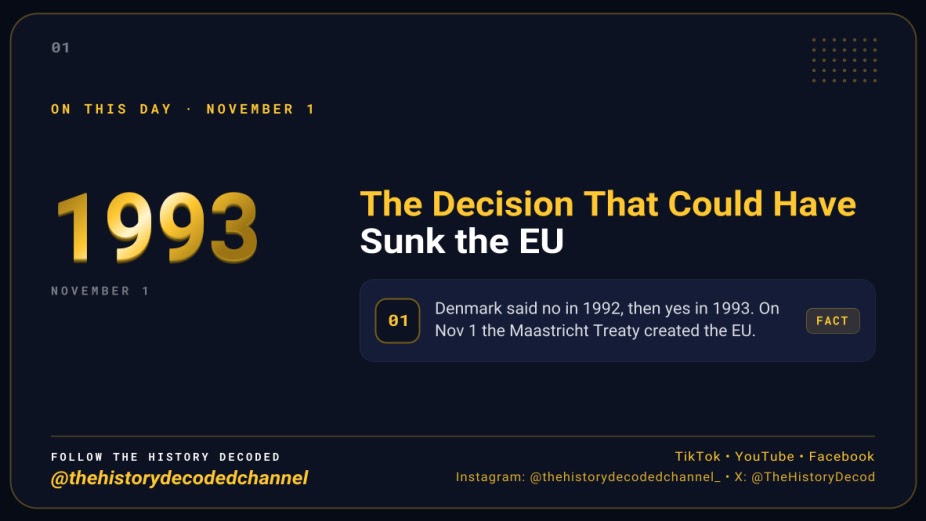
In February 1992, twelve European nations signed the Maastricht Treaty. It could only take effect if every member ratified it. On June 2, 1992, Danish voters rejected it, 50.7% to 49.3%.
That was the moment of decision. Instead of dropping the treaty, leaders negotiated the Edinburgh Agreement, which gave Denmark four opt-outs, including one from the single currency. On May 18, 1993, Danes voted again and 56.7% said yes.
What if they had said no a second time? Because every member had to ratify, a second rejection could have forced a full renegotiation and delayed the whole project. That is a hypothesis. What actually followed: on November 1, 1993, the European Union was born.
Should one country's vote be able to stop a treaty signed by twelve nations?
Instagram: @thehistorydecodedchannel_ · X: @TheHistoryDecod
#TheHistoryDecodedChannel